
Searching Washington County Criminal Dockets
Pull out whatever paper you already hold. A citation, notice, bond paperwork, or court order should name a court, and it may carry a cause or docket number too. The Washington County District Clerk keeps the felony files once a grand jury indicts, covering the 21st and 335th District Courts. For Class A and B misdemeanors, the county criminal office handles matters through County Court at Law and the County Clerk. Fine-only charges land in a Justice Court or the Brenham Municipal Court.
The county clerk pages connect covered files to iDocket. You can search there by defendant, cause number, file date, county, court, attorney, or bondsman. One caution: portal coverage varies by court. A blank result means you should call the relevant clerk, not assume no case exists.
- Read the paper for the court, precinct, and cause number.
- Select Washington County and the correct court in iDocket.
- Search by cause number first, or pair a name with a filing-date range.
- Open the case history and match the charge and court.
- Ask the custodian for a plain or certified document when the docket alone is not enough.
Washington Felonies After Indictment
After indictment, a felony moves to the District Clerk lane. That office files the cause for district criminal cases. It also keeps the pleadings, instruments, and papers. Both the 21st and 335th Judicial District Courts sit at the Washington County Courthouse. The official directory lists both with criminal jurisdiction. The district coordinator manages settings at the court's direction.
Suppose a felony result shows no current date. Compare the iDocket case history against the newest signed notice or order. Then call the District Clerk at 979-277-6231 or the district coordinator at 979-277-6200. Keep timing in mind. A booking or bond event can predate the district cause. It neither replaces the later criminal docket nor proves which district court holds the case now.
Inside a Washington Criminal Docket
Think of a Washington County criminal docket as a timeline of case activity. It traces what was filed and what the court set. It may not show every underlying image. The Justice Court sample in Washington County uses practical columns. These include docket number, time, charge, officer, attorney, and status. District and county records go further, adding pleadings, bond activity, pleas, judgments, and post-judgment events.
| Cause or docket number | The court identifier, sometimes shown in a year-number pattern such as 2016-001; the example is a format hint, not a real case. |
|---|---|
| Charge | The alleged offense and level shown by the court record. |
| Setting | Arraignment, pretrial, trial, sentencing, or another scheduled event. |
| Plea and motions | Recorded responses and requests filed for court action. |
| Disposition | Dismissal, plea result, verdict, judgment, or sentence as entered. |
Read the full entry, always. A short status label can leave out the reason, the terms, or a later order.
Washington Misdemeanors Use Another Lane
Class A and B misdemeanors ordinarily sit in County Court at Law. The County Clerk serves as clerk for this non-family county-court business: citations, writs, judgments, bonds, and jury work. Cases arrive two ways. The County Attorney can file one. It can also come up as an appeal from a Justice or Municipal Court. The official Washington County criminal page lays out the local scope, phone routing, and iDocket path.
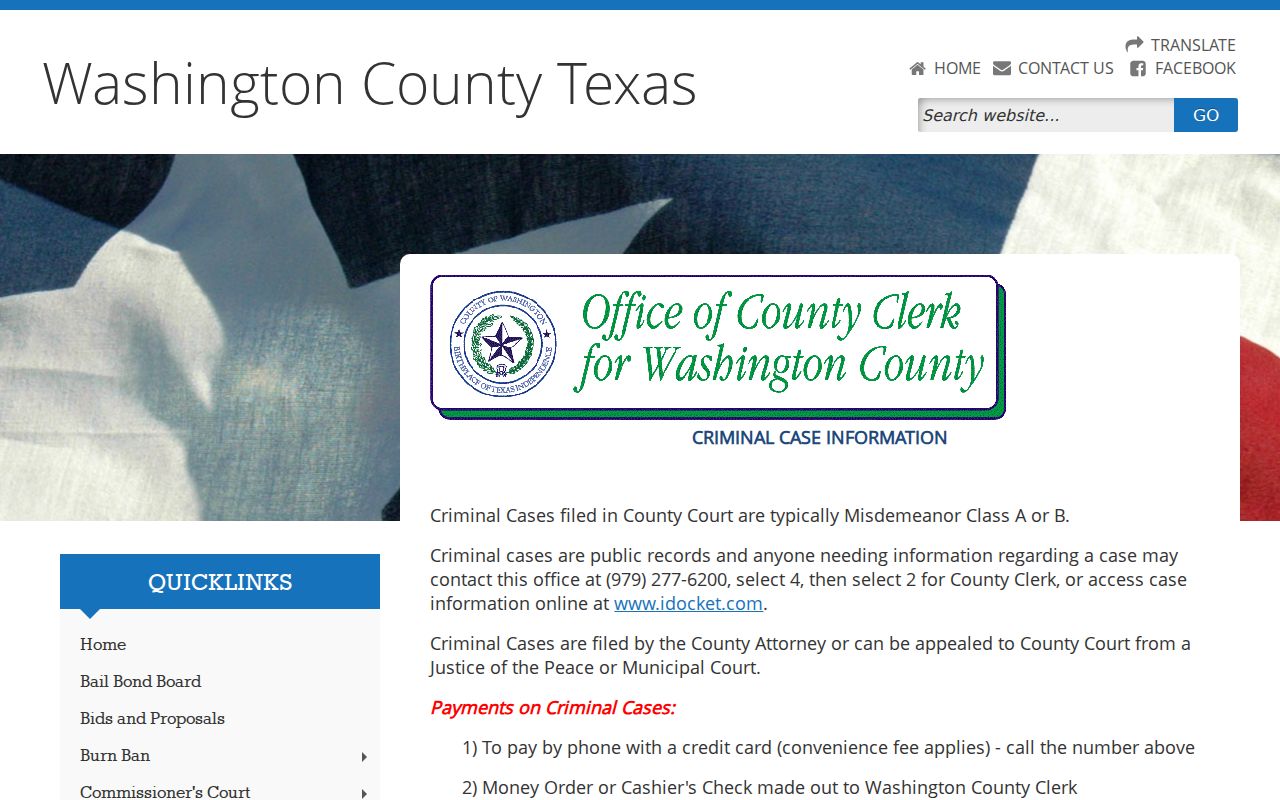
The county page ties the docket search to the criminal office. That single link keeps a misdemeanor lookup from landing on the District Clerk's felony desk.
How a Washington Criminal Case Moves
Entries accumulate as the clerk accepts filings and the court acts. A typical path reads: Filing or indictment › arraignment › pretrial › plea or trial › disposition › sentencing. Some causes add bond proceedings, continuances, motions, or post-judgment work.
A reset moves a setting. It is not a dismissal. Washington local rules require court approval to reset, add, or remove a case, and the reset form must show the next setting before counsel is excused. A defendant who signs a reset and then misses court may face bond forfeiture. For the date-confirmation path, see the Washington County court dates page.
Washington Pretrial Labels in Plain Terms
The posted JP1 docket shows why short labels need context. PRE-TRIAL marks a stage before trial. PRE-TRIAL HEARING names a scheduled event within that stage. Neither phrase says the charge was proved or that the case ended.
- Arraignment
- A proceeding for advising the accused and recording a plea or response.
- Reset
- A court-approved move to a new setting.
- Disposition
- The outcome entry, such as a dismissal, judgment, or plea result.
- Bond forfeiture
- An action tied to a missed bond condition; it is not itself a conviction.
- Nondisclosure
- An order that limits public disclosure for an eligible record; it is not expunction.
Check the entry date and the next event to judge whether a label is still current.
Courts Holding Washington Criminal Dockets
No single criminal database covers Washington County. Felony causes go to the District Clerk and the district courts after indictment. Class A and B misdemeanors go to County Court at Law and the County Clerk. Justice Courts handle fine-only and Class C matters within their jurisdiction. Brenham Municipal Court takes city ordinance, traffic, and other municipal Class C cases.
| Charge path | Court | First contact |
|---|---|---|
| Felony after indictment | 21st or 335th District Court | District Clerk |
| Class A/B misdemeanor | County Court at Law | County Clerk |
| Fine-only or JP citation | Justice Court, Precinct 1-4 | Named precinct |
| Brenham city charge | Brenham Municipal Court | Municipal clerk |
Burton's municipal court went inactive in 2021, and the city posts no docket portal. Route a present Burton matter from the issuing paper, often to JP4.
Washington Docket Versus Filed Record
A docket hit proves only what the index shows. It is not the indictment image, the signed judgment, or the certified order. Access runs in layers. You get a search result, then a docket history, then available document images, and finally a clerk-certified copy. Each layer carries its own limits and costs.
For a certified criminal judgment, give the right clerk the cause number, court, document name, and date. Say whether you need a plain or certified copy. County guidance lists plain copies at $1 per page. Certified copies run $1 per page plus $5 for each certification, and certified copies are mailed for validity. Fees change, so check with the clerk.
Sealed Dockets and Public Access
Judicial records in Texas take a different route than the usual agency request. The Texas Judiciary Open Records Policy points requesters toward Texas Rule of Judicial Administration 12 and other law. Under Rule 12, you may usually inspect and copy judicial records during business hours. Listed exceptions still apply. The rule never forces a custodian to build a new record for you.
Access has other limits too. Juvenile records, sealed material, protected identifiers, expunctions, and nondisclosure orders can all bar the public from a docket file. Deferred adjudication counts as a disposition, not an automatic eraser. A docket search can still come up empty. That may simply mean a misspelled name, the wrong court, an old paper series, or a gap in portal coverage.
Key access rules:
Texas Rule of Judicial Administration 12 governs judicial-record access and exceptions.
Texas Family Code Chapter 58 restricts ordinary access to juvenile records.
Code of Criminal Procedure Chapter 42A covers deferred adjudication and nondisclosure provisions.
Confirm Washington Criminal Settings
Need a live answer about a setting? Call the coordinator, not the clerk. For a district cause, coordinator Marissa Daniels is listed at 979-277-6200 and mdaniels@washingtoncountytx.gov. County Court at Law coordinator Hannah Bentke uses the same main number at extension 5323. Her email is hannah.bentke@washingtoncountytx.gov. The clerk handles file access; a coordinator handles questions about a court date that is coming up.
Before you call, pull out the newest notice. Have the cause number, court, setting type, and date in front of you. What if the portal and the notice disagree? The signed current order controls, and a same-day call to the court settles it. A busy line or an old posted sheet does not mean the hearing was cancelled.